



Where Does HDR10+’s Dynamic Metadata Actually Come From?
A persistent misconception about HDR10+ is that its metadata is somehow secondary: generated only for select titles, produced by hand after the fact, or even translated from another format’s data once content is already finished. None of that reflects how the format actually works, and the real mechanism is worth walking through, because it’s also the reason HDR10+ scales as easily as it does.
It’s a byproduct of grading, not a separate production step
In plain terms, HDR10+ metadata is the data that tells a display how to optimize brightness and contrast scene by scene, separate from the picture itself. HDR10+ metadata is authored at the same point in the pipeline as everything else about the picture: during color grading. A colorist grades the finished image on a reference monitor exactly as they would for any HDR deliverable. Mastering software then performs a statistical analysis of each graded scene’s luminance characteristics and derives the metadata directly from that analysis, automatically, without a colorist running a separate metadata pass.
That’s deliberate. The standard is built so the colorist’s attention stays on the grade itself, not on authoring HDR10+ data as a distinct task. The metadata is a direct read of decisions already made on the color-grading bench, carried forward as data.
Because the process is automatic, it isn’t limited to big-budget mastering suites. HDR10+ metadata can be generated during post-production mastering, live productions, or transcoding for distribution (UHD Blu-ray, OTT streaming, broadcast) using tools available in both professional and mobile workflows. There’s no need to pre-compute, store, or archive it separately; it’s simply generated at encode time. That’s the actual reason HDR10+ content shows up as widely as it does: nothing about the format makes it expensive or rare to produce. For viewers, that’s what keeps the list of HDR10+ titles growing: content providers don’t need a costly extra production step to add support release by release. The same automatic principle carries into HDR10+ ADVANCED, the format’s extended metadata tier: more metadata, generated the same automatic way, not a manual step.
What that statistical analysis actually does
The “statistical analysis” step isn’t a black box. At its core, it’s answering one question for each scene: how much visual detail is sitting at each brightness level, from the darkest shadows to the brightest highlights? Some scenes pack most of their detail into a narrow range (a dim interior with subtle shadow gradations, say); others spread it more evenly. That map of where the detail actually is what the metadata carries.
The display’s brightness curve that gets built from it follows one simple rule: protect the ranges that are doing a lot of work, and simplify the ranges that aren’t. Where a scene has a lot of detail packed into a brightness range, the curve stays steep there, preserving the separation between those tones so nothing gets crushed together. Where a scene has almost nothing going on in some other range, the curve can flatten out and compress it, because there was no visible detail there to lose in the first place.
The rule doesn’t stop at shadows. If a scene has a small but real pocket of detail sitting near the top of the brightness range, a bright window, an explosion, a highlight glint, the curve steepens again right there too, protecting it the same way it protected the shadows. The curve is responding to where the detail actually is, not applying a blanket assumption that highlights don’t matter.
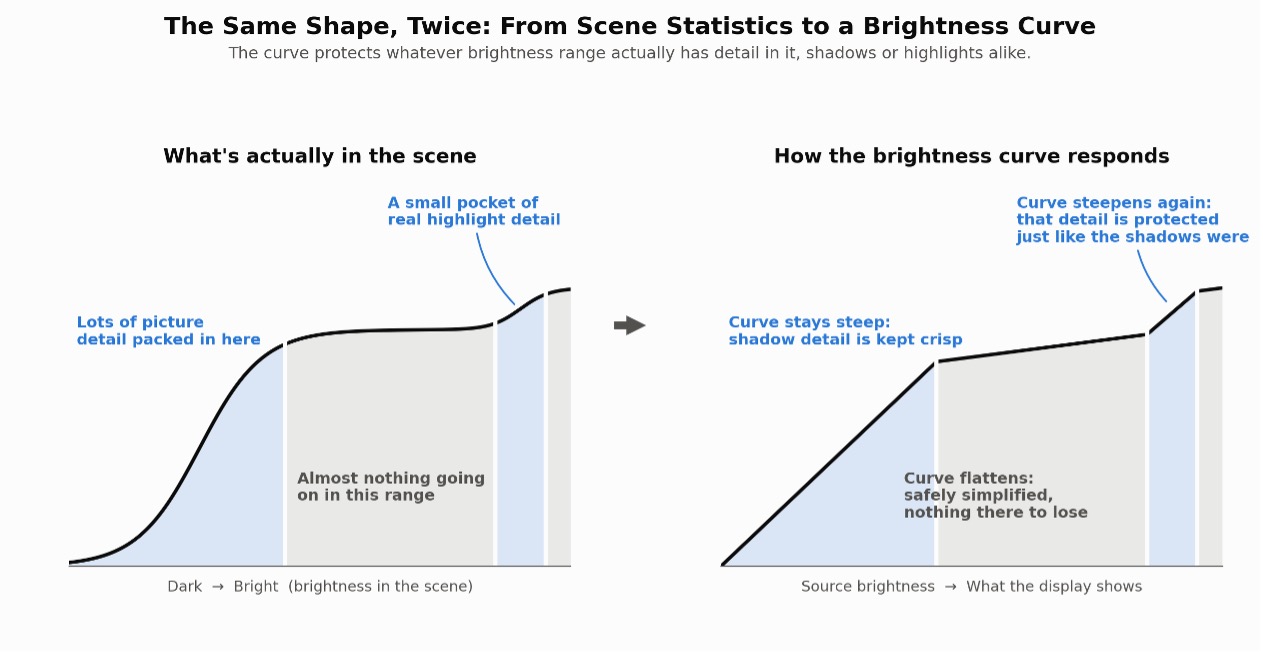
The same shape appears twice: a map of where a scene’s detail actually is, and the brightness curve shaped to match it, including a small protected pocket near the top of the highlight range.
That’s the mechanism behind “preserving creative intent”: the curve isn’t a generic one-size-fits-all adjustment, and it isn’t guessing. It’s shaped, scene by scene, around what’s actually present in that specific shot, so the colorist’s shadow detail, midtone character, and highlight rolloff all survive the trip to a display that has different brightness limits than the mastering monitor did.
It isn’t converted from anything else
Where the “conversion” idea breaks down is worth stating plainly: HDR10+’s dynamic metadata (standardized as SMPTE ST 2094-40) is derived independently from any other dynamic-metadata HDR format. (To be clear, this isn’t a comparison between HDR10+ and HDR10+ ADVANCED: ST 2094-10 belongs to a separate company’s HDR format entirely.) A clear proof point is HDR Dual Carry, a real-world encoding capability already in broadcast use (Gray Television’s ATSC 3.0 rollout across 40+ US markets is a live example). Dual Carry embeds two separate dynamic-metadata tracks, SMPTE ST 2094-40 (HDR10+) and ST 2094-10, as distinct SEI messages inside the same encode. Each display reads only the track it supports and ignores the other.
That only works because both tracks are independently derived from the source grade in the first place. If HDR10+ metadata were a downstream translation of another format’s data, there would be nothing for a display to “read independently”: there’d just be one derived track and a converted copy riding along with it. Dual Carry exists precisely because that’s not the architecture: it’s two parallel, natively-derived metadata streams, each carrying the same creative intent to whichever display is watching for it.
Certification is what guarantees that intent survives to the screen
Authoring the metadata correctly only solves half the problem: the display still has to interpret it correctly. That’s what the HDR10+ certification program exists to guarantee. Every display carrying the HDR10+ mark has been independently tested at an Authorized Test Center against defined thresholds for luminance accuracy, color gamut, and tone-mapping performance, specifically checked for the two most common HDR failure modes: highlight clipping and washed-out, flattened contrast. A display that fails any of those tests doesn’t get to use the mark, regardless of its other specs.
That’s the guarantee in practice: two certified HDR10+ displays from two different manufacturers, tested against the same thresholds, will both reproduce a given piece of HDR10+ content correctly: not clipped, not washed out, not misread. Certification doesn’t standardize how good a panel is (a higher-end display still outperforms a budget one). It standardizes whether the creative intent, as carried in the metadata, actually reaches the screen intact.
Put together
The metadata isn’t manually produced per title, it isn’t scarce, and it isn’t a translation of some other format’s data arriving after the fact. It’s an automatic, direct output of the same grading work already being done, carried independently through the pipeline, and delivered to displays whose certification exists specifically to make sure that creative intent shows up on screen the way it was made.
None of this happens in a vacuum, either. HDR10+ is backed by an ecosystem of well over 180 companies spanning displays, source devices, content, and mastering tools.
Visit the HDR10+ Adopters Page →
Related reading