


HDR10, HDR10+, or HDR10+ ADVANCED? The Spec Sheet Side by Side
HDR10, HDR10+, and HDR10+ ADVANCED aren’t three competing formats — they’re three generations of the same open standard, each one backward compatible with everything before it. That makes the naming genuinely confusing: what actually changed between them, and does the version number on a box or streaming badge matter for what you’ll see on screen?
The one thing all three share
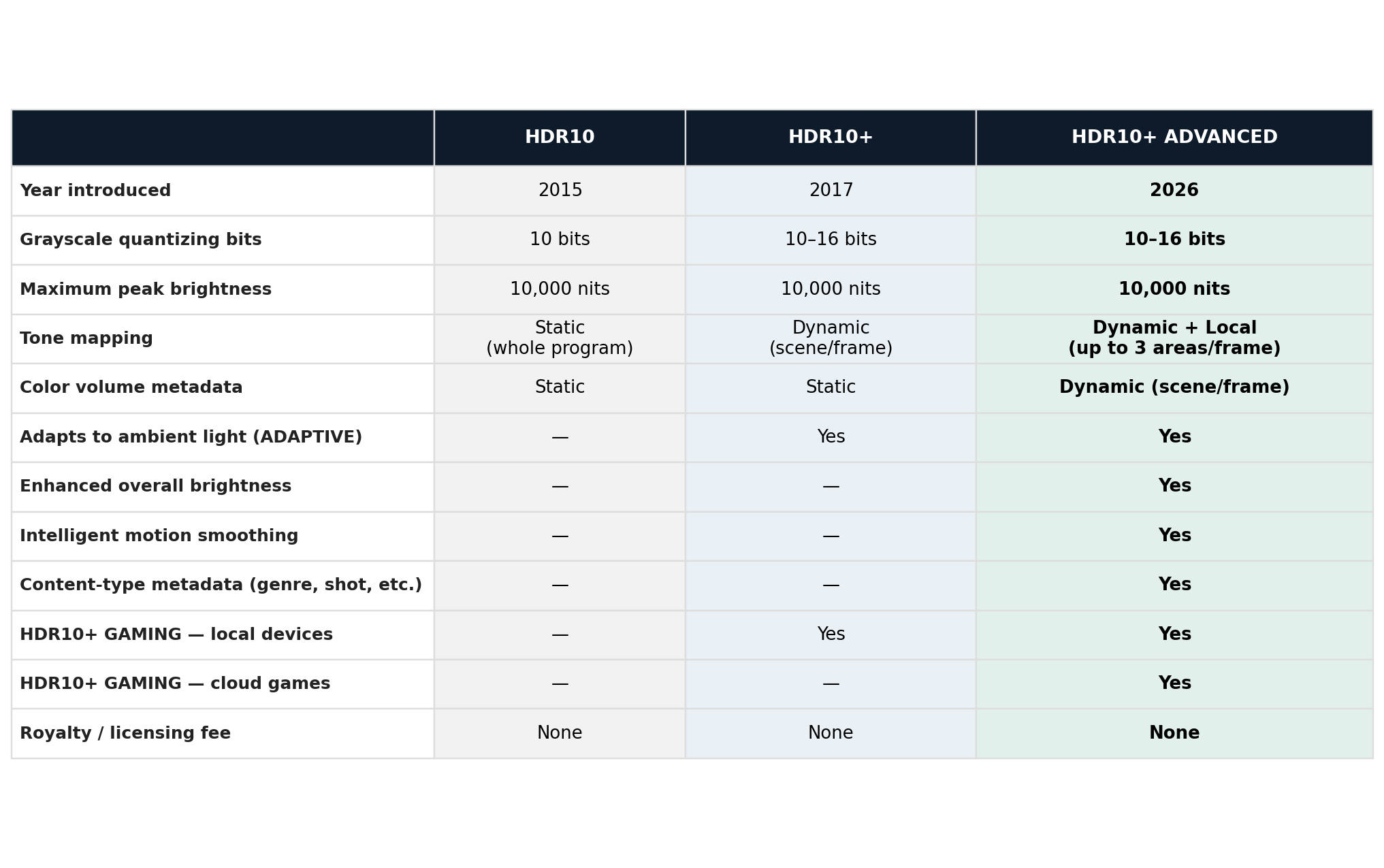
Every generation is built on the same foundation: Perceptual Quantization (PQ), royalty-free licensing, and full backward and forward compatibility. A HDR10+ ADVANCED television can display base HDR10 content just fine, and a basic HDR10 television can play HDR10+ content — it simply ignores the extra dynamic metadata it doesn’t understand and falls back to the static baseline. Nothing in this comparison is about one format “replacing” another; it’s about how much additional information each generation gives a compatible display to work with.
HDR10: the universal baseline
HDR10 is the format every HDR-capable device supports — it’s the floor, not a competing option. It uses static metadata: one tone-mapping and color instruction set for an entire program, calculated from the single brightest moment. That’s straightforward to implement and universally compatible, but it means every scene gets the same treatment regardless of how bright or dark it actually is.
HDR10+: metadata that adapts to the scene
HDR10+ keeps everything HDR10 does and adds dynamic metadata — scene-by-scene (or frame-by-frame, for live broadcast) tone-mapping and color-volume instructions instead of one static curve for the whole program. It also introduces HDR10+ ADAPTIVE, which factors in a room’s ambient light, and HDR10+ GAMING for compatible PCs and displays. All of it remains royalty-free.
HDR10+ ADVANCED: more metadata, more precision
HDR10+ ADVANCED extends the same dynamic-metadata approach further: statistical brightness metadata precise enough to support Enhanced Overall Brightness on today’s highest-peak-brightness displays, Local Tone Mapping for up to three independently-treated areas within a single frame, Intelligent Motion Smoothing tuned per content type, content-type metadata for genre-aware processing, and Advanced Color Control for more precise wide-gamut color reproduction. It also extends HDR10+ GAMING to cloud gaming platforms.
So which one actually matters to you?
If you’re checking whether a TV, streaming title, or disc will display in HDR at all, HDR10 support answers that question — it’s guaranteed everywhere. If you’re comparing two displays or two versions of the same content and want to know which will look more consistently well-optimized scene to scene, that’s the HDR10+ dynamic-metadata difference. HDR10+ ADVANCED’s additional capabilities matter most on today’s newest, brightest premium displays and for content specifically mastered to take advantage of them — the gap is real, but it’s the smallest of the three jumps, and it’s the one still expanding into new devices and titles.
Independent confirmation
Audio Advice’s comparison of current HDR formats notes that HDR10+ continues to expand, giving viewers another excellent dynamic HDR option that delivers outstanding results when well implemented — and specifically calls out that its royalty-free licensing is what has driven its broader adoption across TV brands and projector manufacturers alike.
Read Audio Advice’s full HDR format comparison for more detail.