


The Color Range Your TV Has Been Missing: What Wide Color Gamut Means for HDR
4K and 8K get most of the marketing attention, but resolution only controls how much detail a picture can show — not how vivid or realistic its colors look. That’s a separate property called color gamut: the total range of colors a video format or display can represent. HDR content is built around a much wider color gamut than standard video, and it’s one of the most underappreciated reasons HDR looks more lifelike.
What “gamut” actually measures
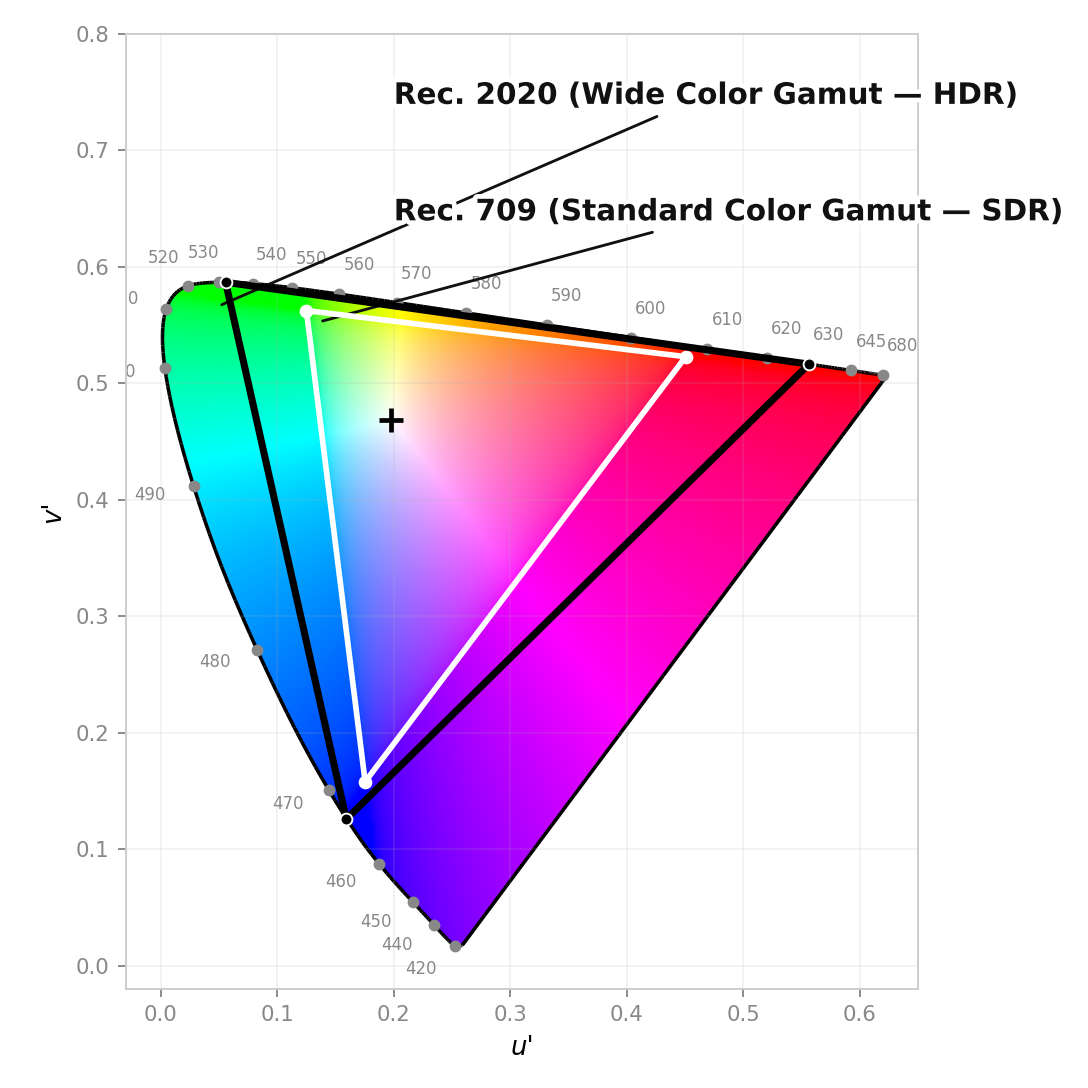
Human vision can perceive a huge range of colors — every hue and saturation visible under normal light. No video format or display can reproduce all of it, so each one is built around a defined subset: its gamut. Standard-definition and standard HD video use a color space called Rec. 709, which was designed decades ago around what CRT and early flat-panel displays could actually produce. Ultra HD and HDR content moves to a much larger space called Rec. 2020, deliberately built to get closer to the full range of color human eyes can see.
Why more colors means more realism, not just “more vivid”
A wider gamut isn’t just about making colors look punchier for its own sake — it’s about accuracy. Real-world scenes contain saturated colors that standard color spaces simply can’t reproduce: the deep red of a stoplight, the intense green of foliage in direct sun, richly saturated skin tones. On a standard-gamut display, those colors get compressed down to the nearest color the format can represent, which is a form of information loss — similar in spirit to how limited brightness range clips highlights and shadows. A wide-gamut HDR display doesn’t need to compromise on those saturated colors the way older formats do.
How HDR10+ takes advantage of it
Color gamut and dynamic range work together, not separately. HDR10+’s dynamic metadata doesn’t just optimize brightness scene-by-scene — the underlying color volume metadata (the combination of color gamut and brightness range together) is part of what each display uses to reproduce a scene as accurately as its hardware allows. A wide color gamut on its own is only as useful as the display’s ability to actually hit those color primaries, which is exactly what HDR10+ certification is designed to verify.
What this means for what you actually see
In practice, wide color gamut shows up most obviously in high-saturation content: sunsets, neon signs, fireworks, sports uniforms, and vivid nature footage. It’s a big part of why HDR content can look meaningfully different from standard content even at identical resolution — the extra color information is there in the source, and a wide-gamut HDR10+ display has the range to actually show it.
Independent confirmation
Android Authority’s technical breakdown of color gamut standards notes that Rec. 2020 covers roughly 75.8% of the CIE spectrum, compared to DCI-P3 at 53.6% and Rec. 709 at 35.9% — more than twice the color range of the standard gamut used by non-HDR video, confirming just how significant the jump to wide color gamut really is.
Read Android Authority’s full guide to color gamuts for more on how these standards compare.