


The Chip Behind the Picture: How Amlogic Brings HDR10+ to Your Screen
HDR10+ is usually described by what you can see: a brighter highlight, a deeper shadow, a scene that keeps its detail. What gets far less attention is where that work actually happens. On a smart TV, a set-top box or a streaming device, every HDR10+ picture passes through a system-on-chip that decodes the video, reads the metadata and decides how each scene is shown. Amlogic designs those chips, and is an HDR10+ Adopter.
The chip is where HDR10+ metadata gets put to work
Standard HDR10 describes a whole movie with one set of instructions, based on its single brightest moment. HDR10+ adds dynamic metadata: a fresh set of instructions for each scene, so a dim interior and a sunlit exterior each get a curve built for them. That metadata is generated automatically from the grade when the content is mastered or encoded, which is a large part of why it travels so easily with the video.
Metadata on its own changes nothing, though. A chip in the playback device has to read it and act on it. That is the part of the pipeline a viewer never sees, and it is where a display’s own brightness and color limits meet the creator’s intent.
A set-top box and a smart TV use the same metadata in different ways
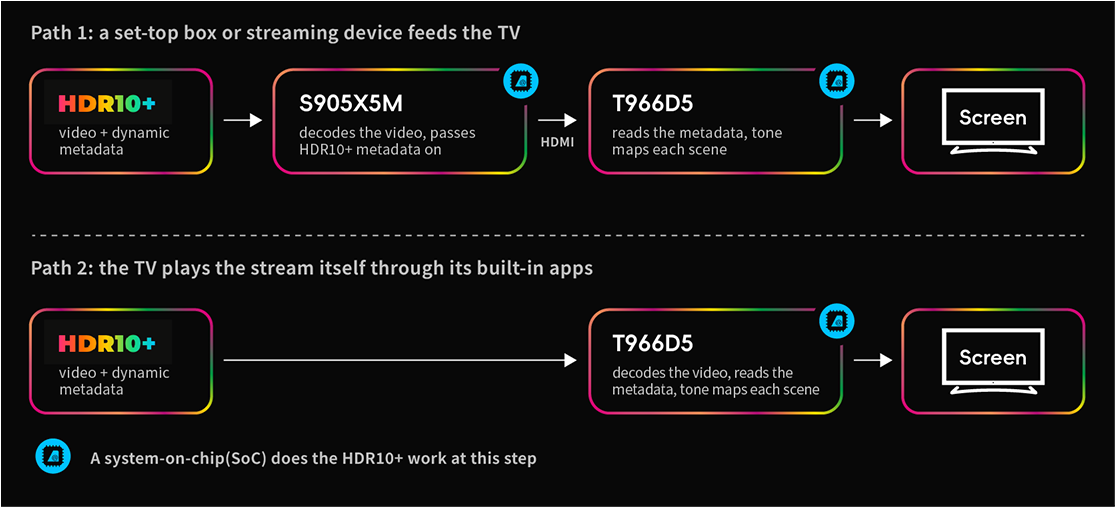
When a streaming box or set-top box plays HDR10+ content, its chip decodes the stream and passes the HDR10+ metadata on to the TV over HDMI. The TV’s chip then does the tone mapping, shaping each scene for the panel it is driving. When the TV plays the stream itself through its built-in apps, a single chip does both jobs.
Either way, the viewer gets the same result: a picture shaped scene by scene for the screen in front of them, rather than one compromise curve for the entire title.
Amlogic builds the chips for both ends of that path
Amlogic is a fabless semiconductor company specializing in system-on-chip solutions for consumer electronics and commercial applications. Its SoCs power smart TVs, set-top boxes and streaming media players, as well as audio systems, AIoT platforms and wireless products. Amlogic is headquartered in Silicon Valley, with R&D, support and sales offices around the world.

Its families range from 4K and 8K set-top box and streaming platforms to smart TV processors, from cost-effective FHD televisions to high-end 4K designs. To find out which Amlogic platforms support HDR10+, see Amlogic’s website or contact Amlogic directly. Finished products built on these platforms appear in the HDR10+ certified products list.
An open standard lets chip makers build their own implementation
HDR10+ is an open, royalty-free standard. There are no per-device royalties payable to HDR10+ Technologies, LLC, and each Adopter chooses its own implementation, so engineering decisions stay competitive and flexible. HDR10+ is also backward compatible with HDR10, so a device that only understands HDR10 still plays HDR10+ content, using the static metadata alone.
Certification is what makes the logo a verified claim
Openness does not mean anything goes. Devices carrying the HDR10+ mark are independently tested at HDR10+ Authorized Test Centers against published test specifications, so the logo on a product is a verified claim, not a self-declaration. For chip makers and the brands that build on their platforms, that creates a clear quality floor to design toward.
HDR10+ ADVANCED gives the chip more to work with
HDR10+ ADVANCED is the latest evolution of the format. It adds six enhancements: extended brightness support, Intelligent Motion Smoothing, Local Tone Mapping for specific regions of an image, genre-based optimization, advanced color control and adaptive cloud gaming. Each one arrives as richer metadata that a chip has to read and act on, which is why silicon makers are central to how these features reach TVs, set-top boxes and streaming devices.
Put together
The picture on your screen is shaped by metadata made during mastering, carried with the video, read by a chip, and applied to the panel in front of you. Amlogic builds the chips that do that reading, in the boxes that stream the content and the TVs that display it. None of this happens in a vacuum, either. HDR10+ is backed by an ecosystem of well over 180 companies spanning displays, source devices, content and mastering tools.
Learn more about Amlogic and its SoC platforms for set-top boxes, streaming devices and smart TVs, or see who else is building on HDR10+.
Visit Amlogic → Amlogic products → HDR10+ Adopters →